×

11+ Ways to Increase Your Conversion Rate Right Now

Category: Guest Posts

11+ Ways to Increase Your Conversion Rate Right Now

Whether we like it or not, the success of a business depends on the business they bring in. It’s not a coincidence that Marx was just a great economist. Economy is more inclusive than most people give it credit for. conversion

Your conversion rate, therefore, is a direct factor in your success and growth. There is no end to the jargon that floats around conversion optimization and analytics. But how often do you come across technically viable options to get your conversion rate going upwards on the graph?

If you are looking for actionable ways to increase your conversion rate and maintain a steady growth, this blog is for you. We will cover all the nuanced tips and tricks that will give you the edge amongst the competition when it comes to overall conversion online.

Build Trust Through Videos

If you are struggling to get traction on your outreach campaigns the answer is videos. Just the mention of the word “video” will give you a massive increase in clickthrough rates on email.

If you are struggling to maintain a healthy bounce rate on your website, the answer is videos. Nothing captures user time and attention as videos do.

If your landing pages are not converting qualified leads, the answer is videos.

Basically, videos are the bridge from prospect to clients that your leads will walk over willingly. Videos give viewers a sense of trust and inclusiveness that no other means of communication does. An important observation we made was that any industry that requires a high level of trust from service providers, invests a lot on videos.

Videos are a multi faceted marketing tool, not only are they a lucrative engagement tool. But they are extremely self sufficient. You can add call to action buttons within a video to invoke the desired action from your viewers.

Let’s say you create a thoroughly wholesome and enjoyable video that addresses a problem that your product aims to solve. This type of video is called a Product Promo Video, it is an advertisement of sorts.

But if you create enough emotional impact through the problem statement, you create a conversion possibility right there and then. End your problem statement with an impeccable solution, that is: your product or service. And create the effect that your product is the hope your burdened prospect needs to rise from the ashes (solve the oh-so problematic problem).

As you manage this, you create a ten second window where you have the prospect 100% convinced of your product’s value. There and then is the time to pop up a “Subscribe Now” or a “Add to Cart” call to action button within your video. This button will redirect your user straight away to the payment channel, no unnecessary steps. This means instant conversion without any room for the prospect to get distracted.

If you think that is a lot of work, you need to download the free screen recorder by StoryXpress right now! Using this simple browser extension, you can create professional looking, high quality videos within minutes. AND add Call to Action buttons at every crucial point within your video with a single click.

Clean the Clutter

We just saw that catching your prospects when they are super engaged works. But what if your prospects click on your “Pay Now” button and end up in a mess of a payment interface?

Here’s where you see the importance of cleaning the clutter and choosing the right platforms including the right payment interface.

Pro Tip: Looking for the payment interface that offers minimum resistance and makes the payment process as smooth as possible? Try PayTabs!


The number one, most important rule of prospecting is grabbing and retaining attention. When a prospect travels through your pipeline, there are many opportunities you get to take them directly to the desired destination, i.e. the checkout page. But you want what keeps them away from that?

  • Unnecessary forms
  • Ads within videos
  • Hard to navigate menu buttons
  • Irrelevant pop-ups

This is certainly not an exhaustive list. There is a lot more that goes on within your website and landing pages that is a big no no. You can actually use marketing tools that create heatmaps for pages. This will tell you exactly the area in your webpage that is getting little to no activity and thus, it is time to remove it.

Whenever you begin your UX/UI design process, maintain one thing: it should be clear, concise, and extremely easy to navigate. What you see is what you get is the attitude you need for a good design. This is what makes Apple as successful as it is with its products.

Your website might not cater to just one product or service, therefore you need to be mindful of the popups you generate. Because pop ups are a powerful tool, and they can sweep your growth towards both the directions, upwards as well as downwards.

Produce popups and any other promotional call to action with due caution. And definitely don’t use flashy content. Reserve that for ads. On your own website, keep things as sophisticated and concise as possible.

Make due cognizance of any restricted access pages, or any non functional aspects of your website. You can do this by testing your website periodically for a few factors (this is not the same as A/B testing, this type of testing is generally referred to as Quality Assurance/Testing).

Smooth Delivery: Sophisticated Payment Channel

One of the most important things on your entire scheme to convert is conversion itself. You build the trust, give your prospect the nudge, somehow manage to get them towards the logical end of the funnel and boo-hoo you refuse to accept Visa? A weak payment channel is frustrating not just for the client, but for sales managers as well.

Invest in a secure, healthy payment channel that gives your clients options to use their preferred mode of payment. UX design matters throughout your website, including your payment page. Since, most payment channels are outsourced, use a service that gives you the ability to customize your payment channels according to your website design. Don’t lose out on customers during the last stage. A trustworthy, credible payment channel is an absolute must have.

Live Chat is the New Conference Room

Most leads don’t just come over to your website, and instantly add your product to their cart. Buyers are inquisitive, they have questions and they want answers. When doubts about your product arise, a prospect will do one of two things. Either navigate through your website to find the answer, or Google it.

Most of them will Google it.

And that will open a can of worms that you don’t want them to open. You cannot afford distractions that come from opening that new tab, moreover you cannot afford the misinformation that floats on the internet. This is why a live chat option is a must have for instant conversions.

When the prospect sees the live chat button right there in front of them, they think “Okay, I can raise my query right here”. And that’s what they will do. This not only retains their attention to your page, but also lets you give them accurate information and genuinely answer their queries all within minutes.

One Time Offers

A fantastic way to urge your prospects to convert is to set a timer. Now, you can’t really set a timer to the actual purchase, but you can set it to offers. Offers with a time limit offered exclusively to a lead are known as one time offers.

You can plug these in with a ticking clock. Suppose your lead is on the checkout page, but is still not for sure making the decision to convert. A pop-up that says “Claim this Fabulous Offer Only for YOU Valid For JUST 5 Minutes” or “Book within 10 Minutes to Claim a 20% Off on Shipping” can really drive your prospect to hit the pay button. Timers create a sense of urgency, and impatience to the point where the lead thinks it’s better to make the purchase now.

Irresistible Value Proposition

Value proposition is nothing but a simple statement that tells your lead why they should buy from you. It is basically your answer to a consumer asking “What’s in it for me”, ‘it’ here refers to converting.

You can have your website perfectly made out, and your outreach campaigns popping. But if you don’t have an irresistible value proposition, then forget about conversions. Create a proposition for your clients that they cannot say no to.

It could be a unique tool that you offer, or a compelling price point. Spend a little time to draw out a value proposition that stands out. Research your competitors to find out what are the factors that make you stand apart.

A/B Testing

A/B testing or split testing is a simple technique to gather the user’s perspective on each element of your website. A/B testing is done solely to understand what drives your conversions, how to increase conversions, and stabilize conversions. There are many ways to do it and it can be applied on multiple elements of your website/marketing strategy.

You will require a tool for A/B testing specific elements of your marketing campaign or website. Conversion Rate Optimization tools do exactly this. The idea is to gather qualitative and quantitative user insights. And work with these to better your conversions.

Engage through Testimonials

If you have a bunch of loyal customers, it is time to bring them to public notice. They are also now a part of your marketing campaign. Give your customers to provide feedback on your website, like a review box. The more realistic your reviews are, the more credible your brand becomes in the eyes of a lead.

Allows customers to unabashedly explain what they derived from your product or service, you can record these testimonials for testimonial videos that you can plug virtually everywhere throughout your sales funnel. Testimonial videos are an irresistible marketing tool that build trust in your prospects for your brand and product.

Welcome and Address Critique

No one product or service is perfect. All of us have some flaws, people even dump their Teslas and Elon Musk is still the richest man on the planet. There is no need to hide away your flaws but to learn from them. If your industry gets a lot of backlash for some specific factor, then address it front and center on your website. You can even add something about it on your value proposition.

Similarly, if you are getting 1 star reviews, and people offer viable criticism, soak it in. Not all critique is meant to bring you down, and no critique should ever bring you down. If potential buyers come up to you before they quit your funnel and say “Well, your product doesn’t offer feature X, sorry I am out.” then make a note of it. And forward it to your design or production team, and revert back with a reasonable explanation of why you don’t offer that particular feature. And if they still say bounce, make sure to reach out to them again once anything related to that feature pops up.

Give your Audience the Content they Want

Your target audience is made of business professionals. These are not solely your prospects, they do other things as well. And these other things are your window to convert them. If you work in an industry that involves a lot of complex concepts, and acute understanding (pretty much all industries today require this), then one thing you invest your time in is making tutorial videos.

Everybody loves tutorial videos, everybody. No matter their ranking within a business, every professional googles solutions to specific problems. Or looks up concepts or how-to videos on the internet. And when you become the tutor, and successfully help them solve their problem, they have nothing but reverence towards you. And that is your window to convert them. You can very smoothly plugin your products as a viable solution through your tutorial videos and get instant conversions.

Responsive Web Design

Not all your clients are browsing your website on their desktops. Some, a lot of them actually prefer mobile viewing. Google has a mobile first indexing algorithm that takes into account mobile optimization.

Responsive web design is about creating a website that works well regardless of the platform it is being used on. It adapts itself, in every sense for easy viewing and activity. You can make your existing websites responsive, or create an application specifically for mobile viewing and engagement.

All of the above will give your conversion rates a much-needed boost.

If you ever find yourself struggling, put on the glasses of your customers and try to find out what you are doing wrong. After all, when you expect a customer to shed a few bucks on your product, you need to offer quality products.

 

11+ Ways to Increase Your Conversion Rate Right Now
-Suchita Chopra is a content writer for Story Xpress, a marketing and advertising, based in Ashburn, Virginia.


Online payment gateway red flags: 6 signs you need a new one

The best payment gateway service will set your business up for success. At worst, the wrong online payment gateway will put your business at risk of security breaches and lawsuits.

But it’s not always straightforward to spot a bad online payment gateway. Here are 6 red flags to watch out for.

Ease of payment

More and customers are shopping on mobile. Business Insider reports that m-commerce will account for 44% of e-commerce by 2024. Unfortunately, there are many payment gateways that are still not mobile-friendly.

Global online shopping is also on the rise. In 2019, the average international e-commerce basket was valued at 97.87 USD. Before the pandemic, numbers showed that international customers also tend to buy more often. Making customers do math in their head to calculate exchange rates and fees is a sure recipe for checkout abandonment.

A payment gateway that’s not mobile-friendly and doesn’t accept multiple currencies will put you at a disadvantage. PayTabs allows payment in multiple currencies. No matter where your customers are, they can view the fee and pay in their local currency. It’s also mobile-friendly and supports all major credit cards.

Weak security standards

2020 was a year of explosive growth for e-commerce. Sadly, online fraud rose as well with the increase of customers. A found that 37% of customers surveyed had been a target of online fraud. According to LexisNexis, total online fraud attempts per month experienced by U.S based retailers increased by 24.2% in 2020. E-commerce sites now face a host of security risks from cybercriminals.

Find out if your payment gateway provider is compliant with international standards such as Payment Card Industry Data Security Standards (PCI DSS). Choose an online payment gateway that’s 3D secure, uses Secure Socket Layer (SSL) technology, and tokenization. The best ones will have an added in-house fraud protection layer.

Slow payment processing speed

Customers expect a fast checkout – 18% will abandon cart if the payment process is too complex. It also increases complex chargebacks and hurts the user experience. Choose a provider that offers a seamless purchase experience and an intuitive terminal.

In addition to the actual transaction itself, each payment gateway provider has different payout terms and timelines. Delayed payout affects your cash flow, especially if you’re a small or medium enterprise (SME) or a startup. At PayTabs, we transfer deposits to you within two business days. Try a free demo of PayTabs here.

Lack of robust reporting & reconciliation

If your payment gateway doesn’t have sufficient data collection, you’ll be making business decisions on guesswork or worse, wrong data. You need real-time data reconciliation and accurate reporting.

We recently launched PT 2.0, our new enhanced payment gateway. It allows you to track transactions based on volume, revenue generated, and order value including refunded transactions. Product sales can be measured by the day or hour — invaluable for promotions and offers. It also allows you to identify your top customers and reward them.

Incompatible with your goals

Choosing a payment gateway is a long-term investment. Therefore, your payment partner should be a match for your goals. Some discerning questions to ask up-front are:

• Is this payment gateway trustworthy?
• Does this gateway have a track record of success?
• Does this gateway support our business model?
• Does the gateway allow integration with our systems?

PayTabs is a gateway made for service providers trying to enter the MENA region. We’ve been in business since 2014, helping merchants of all sizes across 49 industries. We allow integration across mobile, iFrame, and e-commerce plugins under 24 hours.

Hidden or junk fees

Many online payment gateways have hidden fees. They also use confusing jargon and pricing models. The best payment gateways have transparent, cost-effective pricing.

Junk fees are another hidden cost to watch out for. Common examples of these include:

• Early termination fees
• Monthly minimum fees
• Statement fees
• Customer service fees.

You shouldn’t have to pay to get a monthly statement or talk to customer service.

Let us help you

Start your entry into the MENA market with the best payment gateway. Contact us and talk to one of our representatives today.

Kasun Pathirage
– Kasun Pathirage is an expert freelance content writer for B2B fintech and SaaS brands.
Learn more about his work via his website: verbauream.com.

What are the Biggest Security Threats to eCommerce Business?

The eCommerce industry is currently profitable, with financial experts estimating to surpass $4.5 trillion in sales in 2021. This is attributed to the convenience and other benefits of online shopping. However, despite these benefits, eCommerce companies are face several hurdles on their way to success. One of the major challenges is cyber-security threats, which are currently on the rise.

The success of online shops has brought unwanted attention, with cybercriminals launching sophisticated targeting methods to exploit vulnerabilities within online stores. That said, owners of eCommerce stores should watch out for the following security threats:

  1. Direct Website Attacks

Cybercriminals often use Spear-phishing to hack websites and steal valuable information. However, websites can also face direct attacks, such as Dedicated Denial of Service Attacks, which flood the store with multiple requests from undetectable and malicious IP addresses. Such sophisticated attacks can force your store offline, leaving it vulnerable to vicious attacks, including malware.

DDOS attacks essentially overwhelm your eCommerce store hosting services, blocking the store from providing services to regular visitors. Flooding the store with thousands of requests keeps the site busy to handle requests of your visitors. Experiencing a downtime in your online store is harmful as it exposes it to more vulnerabilities, prevents clients from shopping, and can damage your reputation.

Like viruses and other ransomware, cybercriminals launching DDOS attacks often demand some amount to relinquish their impact and restore your online store’s normal operations. While these attacks can cost your business significant revenue, losing your client’s trust, confidence and reputation is probably the costliest damage from DDOS attacks.

To avoid this, take proactive defensive measures, such as monitoring incoming traffic requests on your servers. Declining illegitimate traffic can help avoid such an overwhelming influx.

  1. Financial Frauds

Most online shoppers trust the use of online transactions when paying for their products or services. However, the increase in the use of online payment methods has attracted financial fraudsters looking to exploit vulnerabilities in these systems. Financial fraud can occur in two main ways:

  1. Credit card theft – this occurs when cybercriminals use stolen credit card information to pay for goods and services from your store.
  2. Fake return and refund fraud – with this, cybercriminals complete fake and unauthorized transactions. Some initiate fake requests for returns.

While it is difficult to trace financial frauds, especially credit card theft, detecting the fraudulent transaction is overly important. Fortunately, owners of eCommerce stores can take note of the following tell-tale signs to stop the fraudulent transaction:

  • A request to ship the product to a different address from the one on the billing address.
  • Successful order followed by several unsuccessful orders.
  • The customers IP address does not match the location on the billing address.

Verifying these transactions before receiving payments and shipping your products can save your store from losses. If you don’t, you will not only pay back the legit owner of the credit card but also lose your inventory. As such, investing in an Address Verification System is prudent.

  1. Malware

Cybercriminals can also design several malicious malwares to damage your systems. Just to mention, malware is a general term for several program hackers use to gain access or damage your computer network. Common malware include:

  • Viruses – these are programs that spread, infect, and damage or corrupt several files and programs.
  • Ransomware – they are programs that alter computer systems’ normal functioning until an action is taken, in most cases, payment of some amounts.
  • Backdoors – hackers use these programs to bypass regular authentication systems to complete fraudulent processes and data theft.

Installing a strong and reliable firewall is the best way of mitigating these threats. You should also work withcybersecurity experts to ensure that your systems are safe.

  1. Bots

Bots are automated programs that perform specific tasks on the internet. Unfortunately, there are both good and bad bots that can promote or bring down your eCommerce store. The majority of these bots aid in installing malware on your computer and abet targeted spear-phishing campaigns. That said, nefarious bots are the most common and harmful automated programs that affect eCommerce businesses.

With bad bots accounting for more than a fifth of eCommerce traffic in 2018, they are a threat to your eCommerce store in the following ways;

  • Promote credit card fraud – some bad bots have been programmed to steal credit card information from sites. Once hackers gather this information, they can make repeated purchases.
  • Account acquisition – there is a big market for login information on the dark web. Hackers can use bots to steal login information and sell them to the biggest bidder.
  • Price scraping – some bots are launched by competitor sites to monitor your product prices, marketing plans, and inventory levels.

Fortunately, avoiding the disastrous effects of bots comes down to simply recognizing them. For this, it is important to secure your eCommerce store with CAPTCHA codes.

Bottom Line

Other significant security threats, such as E-skimming, brute force, SQL injections, and spamming, negatively affect the success of eCommerce stores. As such, online entrepreneurs should implement serious security measures to prevent these threats. Data encryption, using secure payment gateways, and securing websites with SSL certificates are just but a few measures to mention.

Your Helpful PCI-DSS Audit Checklist

Your-Helpful-PCI-DSS-Audit-Checklist

In 2019, global retail sales grew by 3.4% from the previous year to hit $21 trillion. Global eCommerce accounted for 16.4% of total retail sales at $3.46 billion. Ecommerce sales continue to grow, thanks to globalization and the internet. 

This growth also comes with a few challenges, among which is payment card fraud. In 2018, payment card fraud amounted to $27.85 billion and was expected to hit $35.67 billion in the next five years.

If you intend to pursue the e-commerce route, you’ll need to consider a few things, one of which is the payment method. How many payment alternatives will you offer your customers? Are the payment methods secure?

Your customers will offer you their financial data on a silver plate; they expect that it’s secure and confidential. To guarantee this, you need to prove that you’re PCI-DSS compliant.

What is PCI-DSS?

This is a set of standards formulated by the PCI Security Standards Council. This council is made up of major credit card companies who joined forces to create security standards that protect credit card data.

As a merchant, your compliance guidelines are dictated by the number of annual transactions. Merchants are grouped into four levels:

  • Level 1

This covers merchants who handle over 6 million transactions every year or have experienced a data breach.

  •  Level 2

Merchants who handle 1-6 million transactions annually.

  •  Level 3

Merchants with less than a million transactions but more than 20,000 annual transactions.

  •  Level 4

Merchants with less than 20,000 annual transactions.

Each of these levels has different compliance requirements. The more the transactions you process every year, the tougher the compliance requirements become.

PCI DSS Compliance Checklist

PCI has six control objectives that constitute twelve compliance requirements. These requirements are not subject to merchant levels; thus, all merchants are required to adhere to the compliance requirements regardless of transaction volume.

These control objectives include:

  1. Secure Network and Systems

This control objective has two requirements:

  • Protect cardholder data by installing and maintaining a firewall

Firewalls are barriers that protect your network by preventing security threats from accessing or spreading through your network. Firewalls act as filters that determine whether information passing from one computer to another is safe or not.

  • Limit the use of vendor-supplied passwords

Every system comes with security parameters, among which are passwords. These passwords are often easy to hack; thus, you should change them before you deploy the systems. Ensure that you update system configurations and security measures as you identify new threats.

  1. Protect Cardholder Data

Cardholder data refers to personally identifiable information that’s associated with a credit or debit cardholder. According to PCI DSS, cardholder data includes PAN, which is the unique payment card number used to identify the cardholder’s account and the issuer. The standards require that merchants encrypt the transmission of cardholder data and protect stored cardholder data as stipulated in the guidelines.

  1. Implement vulnerability protection programs 

Create a program to help you identify weaknesses in your payment card infrastructure system. Hackers will exploit these vulnerabilities to access your cardholder which you can mitigate by:

  • Implementing measures to protect your systems against cyberattacks such as malware.
  • Maintain secure systems
  1. Access control measures

Limit access to cardholder data by vetting everyone who needs access to this data. This is achieved by:

  • Restricting access to cardholder data

Only authorized personnel should have access to this data. Limit the privileges of everyone to a need-to-know basis and deny all other access unless authorized.

  • Authenticate access

Employees that have access to cardholder data should be assigned unique identification. They will use these identifications to access the data, thus making it easy to track how data is handled. Do not use group IDs; every member with access needs unique identification.

  • Restrict physical access to the data

Your onsite systems are also vulnerable to attacks or internal leaks; thus, you need to put measures in place to limit physical access to cardholder data.

  1. Monitoring and testing networks

Monitor your physical and wireless networks to identify vulnerabilities that cybercriminals can exploit to gain unauthorized access to your systems and data. To prevent cybercriminals from exploiting these vulnerabilities, you are required to:

  • Thoroughly track, analyze, and monitor cardholder environments in search of weakness.
  • Frequently test your system components, processes, etc. to ensure that you maintain security over time. 
  1. Information security

Your business needs a strong security policy that details the responsibilities of your employees towards protecting cardholder data.

Conclusion

PCI compliance isn’t a guarantee that your systems and data are safe; hundreds of companies have experienced data breaches despite being PCI-DSS compliant. Achieving compliance is merely a baseline. You need to meet the requirements as stipulated by the governing body and implement extra measures that protect your systems from emerging threats. You can never be too sure when dealing with cybersecurity, going the extra mile helps prevent cyber attacks.

About the author

Jordan MacAvoy is the Vice President of Marketing at Reciprocity Labs and manages the company’s go-to-market strategy and execution. Prior to joining Reciprocity, Mr. MacAvoy served in executive roles at Fundbox, a Forbes Next Billion Dollar Company, and Intuit, via their acquisition of the SaaS marketing and communications solution, Demandforce.

Go Beyond the Zoom

4 Ways to Add Something Extra to Your Product Visualization

While online shopping comes with the pro of being anytime, anywhere, and wearing anything (hello, 2 a.m. shopping sprees in your Ninja Turtle pajamas), it carries with it the con of not being able to see the product up close and in person. Companies often try to compensate for this by taking a handful of shots of the product from a few angles — and of course, the viewer can always zoom in.

I’ve got news: It’s time to go beyond the zoom.

Ecommerce has been trending toward more sophisticated technological adoption, and product imaging is certainly at the forefront of this movement. Having the zoom option on product images is something that has unsurprisingly been popular in online shopping since it first appeared — we all love to look at the details of a product before we buy it! Also unsurprisingly, technology has adapted quite a bit since then, and it’s time to look into new ways to give your customers the in-person experience of the product without ever having to change out of their PJs.

1. Give them the full 360-degree experience
There’s something amazing about being able to turn a product around and view it from every angle just like you would if it was right in front of you — and that’s what a 360-degree view gives your customer. It can provide a lot more detail than a still photo and descriptive text can, and is far more interactive and immersive than a slideshow from a few different angles.

The best part about this is that you probably don’t need to invest much more than you already are. If you’re doing standard photography, you likely already have a camera, tripod, and backdrop. All you need to transform your plain Jane setup to a 360-degree extravaganza is a turntable and a remote shutter release. It does take more time than a standard few shots, but the payoff can be worth it!

2. Record it in action

If you’re looking for more bang for your buck, consider shooting some videos of your product in action, preferably with someone interacting with it. If you do it right, it can act as both a video marketing tool and a product description. It doesn’t need to cost a million dollars, either; take this simple but effective video of a guy using a Kelly side table. What it lacks in budget it makes up for in humor, and comes across as more endearing and genuine than a fancy schmancy ad campaign ever could.

If you want to produce something higher-quality, try focusing on just a few products, like a new line you’re launching or your best sellers. Then you can go the route of Glory Cycles (get it?) and shoot a really nice video starring your best stuff. The best part about that promotion is how simple and well-executed it is, showing just how effective that visual experience is.

3. Artificial Reality

We’re getting into the cooler (and more expensive) stuff now. You may have heard artificial reality and virtual reality used interchangeably, but they are quite different: Artificial reality is computer-generated imagery overlaid onto the real world (think Pokemon Go). This is perfect for a lot of products, because it can literally show the customer how the product will look on them, in their home, or in their world.

Go Beyond the Zoom

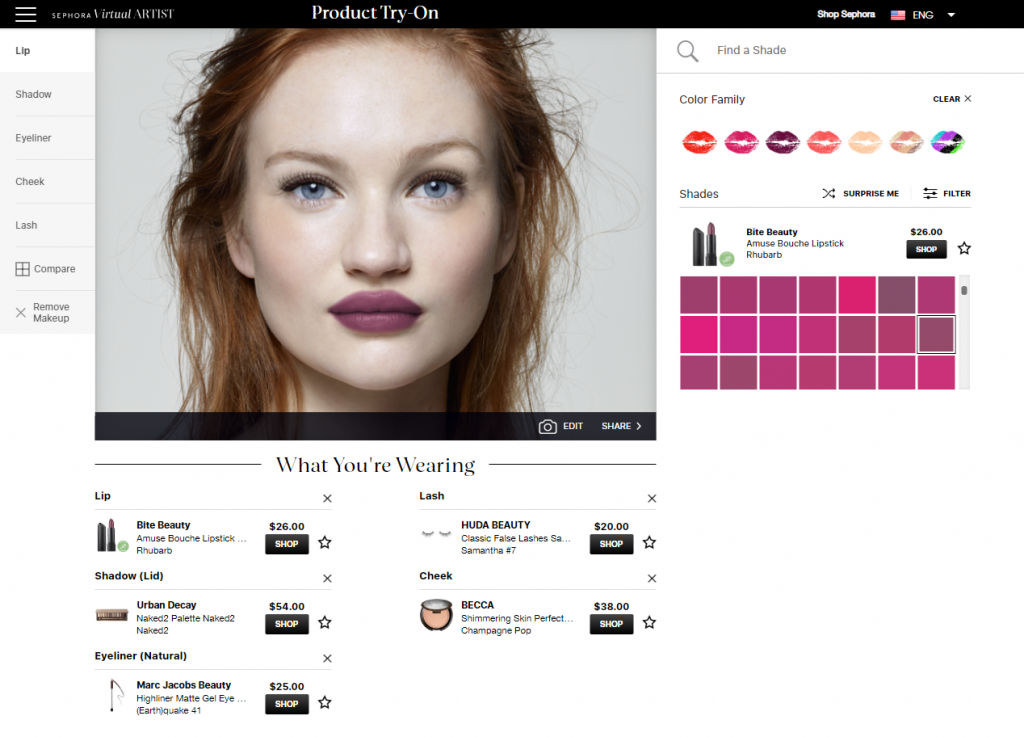
Sephora is quite a pioneer in the beauty world, so it’s no surprise that it has a virtual makeup artist. Using its AR, you can try on different makeup products without ever having to put them on your face — and of course, buy what you like.

Another great application of AR comes from IKEA, which has an app that lets customers hold up their phone and see realistic images of IKEA furniture overlaid onto their room. Far from a badly photoshopped insert, the furniture is accurately placed and measured to look as realistic as possible.

4. Virtual Reality

Finally, the really high-level stuff. Virtual reality is different from artificial reality in that it is a complete view of your surroundings through some sort of lens or goggles, like the Oculus. People call it the way of the future, but it’s still got a ways to go. Due to the cost and complexity, it’s no surprise that most companies have not embraced VR, but it can still spark your creativity and make you think about applications of your products that are a little outside the box.

A few companies have taken the plunge, though. EBay launched the world’s first virtual reality department store, in which customers could view eBay products as if they were in a department store. Shopify hasn’t come out with any VR experiences as of yet, but it has heavily invested in both AR and VR, and hopes to be used in the future as a place to host virtual reality experiences. It’s likely not within reach in the very near future, but it’s an exciting space to keep your eye on.

It’s all about the experience

As technology improves, your customers will expect you to take advantage of it to provide the best online shopping experience you can. How are you wowing your customers?

About the author

Jake Rheude is the Director of Marketing for Red Stag Fulfillment, an ecommerce fulfillment warehouse that was born out of ecommerce. He has years of experience in ecommerce and business development. In his free time, Jake enjoys reading about business and sharing his own experience with others.

PayTabs
Privacy Overview

This website uses cookies so that we can provide you with the best user experience possible. Cookie information is stored in your browser and performs functions such as recognising you when you return to our website and helping our team to understand which sections of the website you find most interesting and useful.